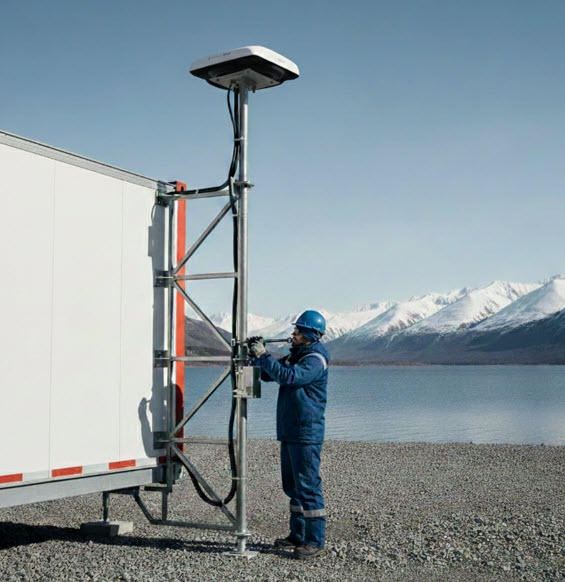
We do not sell airtime. We provide the white-label field services needed to terminate LEO or GEO satellite links in every Canadian climate—from coastal salt spray to prairie winds to Arctic cold. While others rely on standard specs, we account for low-temperature cable performance, code-aware grounding/bonding, and the look-angle geometry that keeps links stable at high latitude
We treat the ground segment as permanent critical infrastructure. Whether for a single remote mine or a nationwide rollout for a bank, our technicians ensure the physical layer supports the Service Level Agreement (SLA).
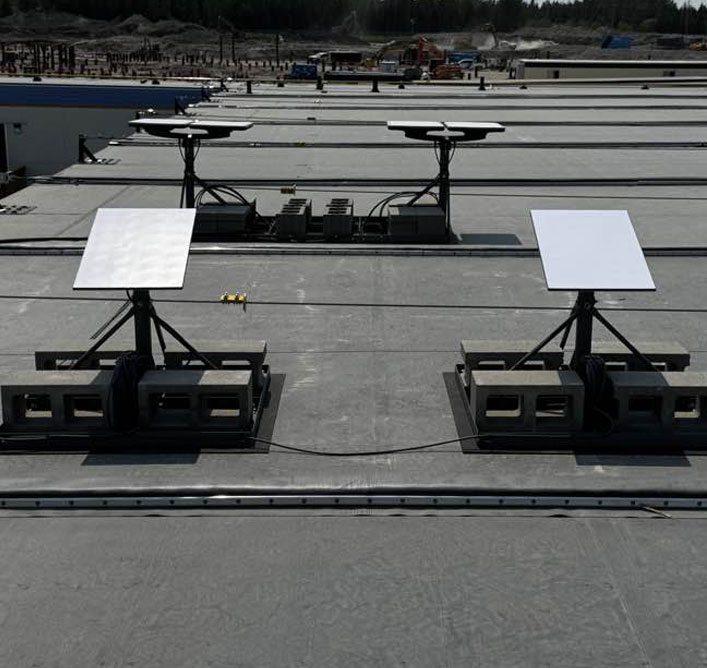
Structural load verification.
Cold-weather cabling, non-penetrating or fixed mounting, and CEC-compliant grounding. Installation requirements can vary depending on the satellite platform. Our guide to Starlink for Business in Canada: Enterprise Installation Decoded explains the considerations for deploying enterprise-grade Starlink systems.
Peaking, cross-pol isolation, and Site Acceptance Testing (SAT).
Bonding satellite with terrestrial fiber or LTE using SD-WAN.
Preventive re-peaking, radome cleaning, and emergency dispatch.
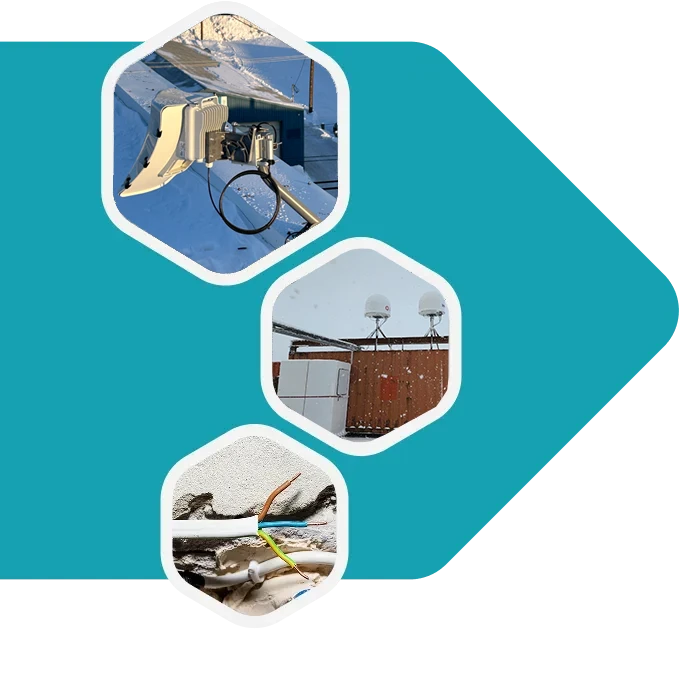
Satellite installation in Canada is an environmental engineering challenge, not just a cable run. In the high Arctic, GEO look angles drop below 10 degrees, forcing signals to travel through a thicker layer of the atmosphere. In these conditions, a standard install fails.
A PVC cable jacket will freeze and crack at -20°C, destroying dielectric integrity. A standard non-penetrating roof mount will drift during freeze-thaw cycles, misaligning the dish by the 1 degree necessary to kill a GEO link. We engineer against these realities.
Standard telecommunications cabling is typically rated for installation down to -20°C. When standard PVC jackets are bent in extreme cold, they undergo a “glass transition” and crack. Moisture enters the crack, wicks down the braid, and corrodes the connector from the inside.
We specify cables with Cold Weather ratings (often -40°C or -60°C). We utilize jacket materials like Thermoplastic Elastomer (TPE) or Cross-Linked Polyethylene (XLPE) which retain flexibility in extreme cold. Specialized materials and installation methods like these are among the factors that affect satellite internet installation costs in Canada for commercial and industrial projects.
Proper grounding is a mandate of the Canadian Electrical Code (CEC). Section 54 requires that the metal shield of the coaxial cable must be grounded at the building as close to the point of entry as possible.
Driving a separate ground rod at the antenna site without bonding it to the main building ground creates a difference in electrical potential. This ground loop causes persistent hum bars on video feeds and can destroy the Ethernet ports on your modem. We install a coaxial grounding block bonded to the main building ground using a minimum of #14 AWG (often #10 AWG) copper wire. We ensure equal potential across the system.
A residential Starlink kit placed on a pallet might work for a cottage, but it does not meet the uptime requirements of enterprise operations.
For business continuity, we exclusively recommend and install the High Performance and Flat High Performance kits. These units feature a wider field of view (140 degrees) allowing them to see more satellites and maintain connection in environments with partial obstructions where standard dishes fail.
Starlink proprietary cables are not rated for direct burial or extreme abrasion.
We route all cabling through UV-stabilized conduit to prevent rodent damage and ice-crush.
We drill and seal proper entry points using fire-rated grommets, ensuring the building envelope’s vapor barrier is not compromised.
Unlike standard coax, Starlink cables cannot be cut and terminated in the field without specialized kits. We plan cable pathways to adhere strictly to the 25m or 8m supplied lengths, or supply verified optical fiber extenders for longer runs.
We install the Flat High Performance kit using the specialized Wedge Mount at an 8-degree angle. This is not for aesthetics; it is an engineering requirement for Canadian operations. The tilt allows water runoff and prevents heavy wet snow from accumulating and bridging the thermal capacity of the internal heater.
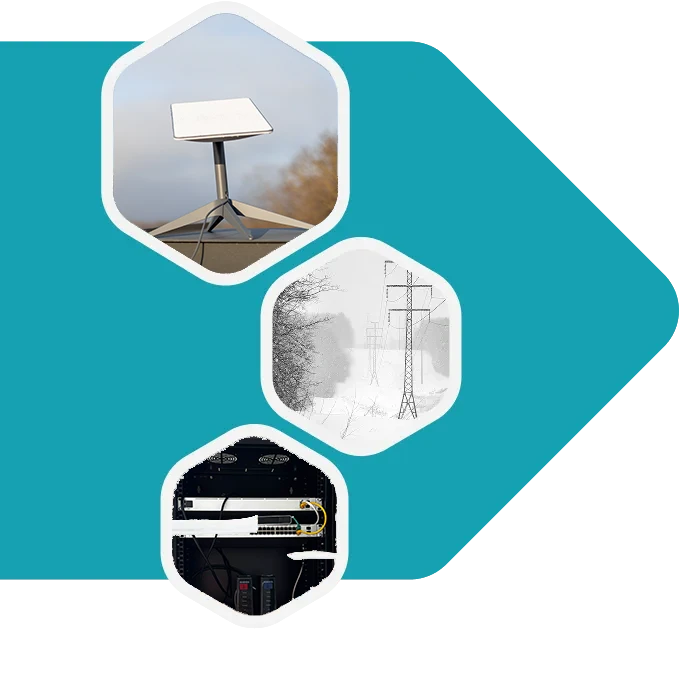
OneWeb offers fiber-like latency with a Service Level Agreement (SLA) suitable for primary connectivity. However, the ground segment is significantly more complex than consumer LEO systems. NTFS technicians are certified to commission the specific antenna classes required for the OneWeb network.
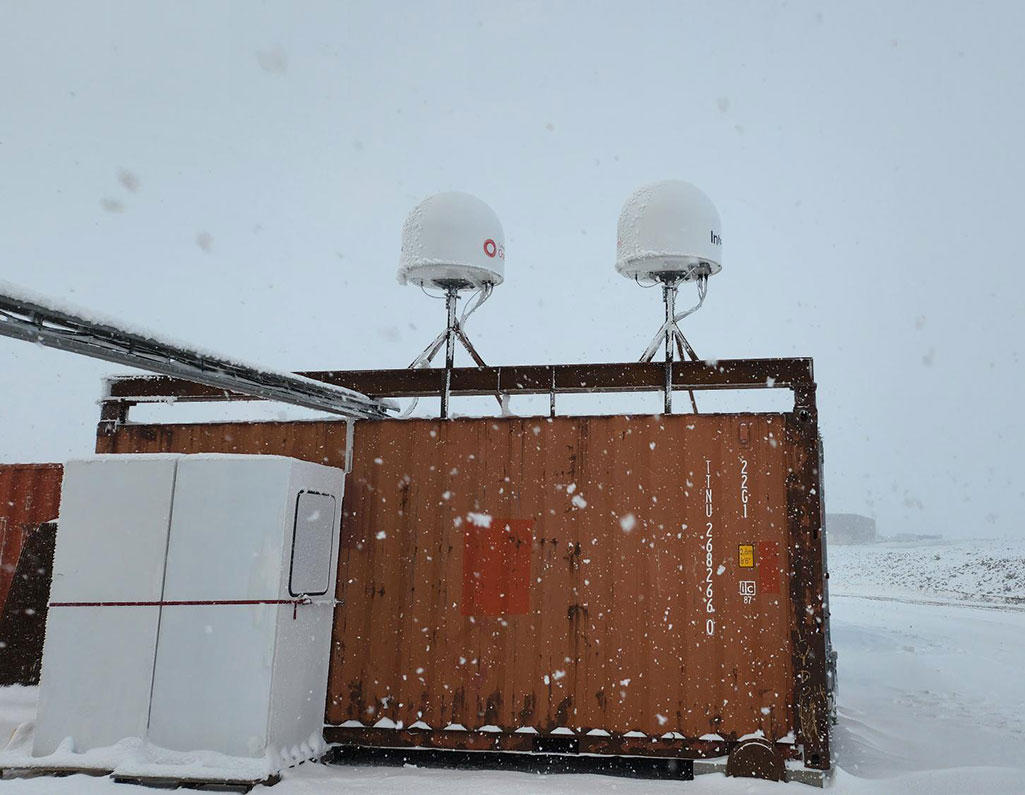
For mission-critical sites (mining dispatch, emergency ops), we deploy dual-dome terminals (such as the Intellian OW70 series).
These units contain complex moving parts. We ensure the mounting platform is vibration-isolated and perfectly leveled to prevent premature motor wear in the pedestal.
Unlike plug-and-play systems, OneWeb terminals require precise commissioning. We interface with the terminal’s local management console to load the Option Files (configuration profiles), update firmware, and validate the look-angles against the site’s specific obstructions.
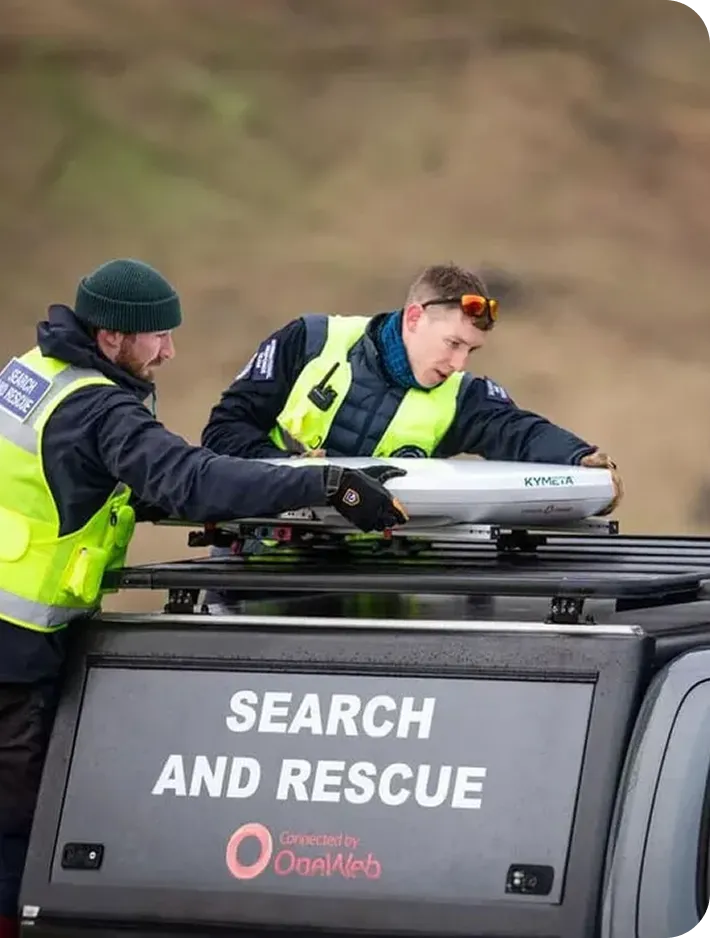
For environments where wind load, aerodynamics, or rapid deployment are the priority, we install Flat Panel ESAs (Electronically Steered Arrays) from manufacturers like Kymeta and Intellian.
ESAs have no moving parts. They track satellites using holographic beamforming. In the Canadian Arctic, moving parts are failure points—gears freeze and lubricants thicken. Solid-state panels eliminate mechanical failure modes, making them ideal for remote, unmanned sites.
We integrate ESAs onto fleet vehicles, rail cars, and mobile command trailers.
We use low-profile mounting rails that withstand highway speeds and heavy wind gusts without creating drag or vibration noise.
We use low-profile mounting rails that withstand highway speeds and heavy wind gusts without creating drag or vibration noise.
Flat panels require significant power to maintain internal operating temperatures in the winter. A Kymeta u8, for example, can draw substantial current when its heaters are active. We audit your site’s DC power budget (solar/battery) to ensure the terminal does not trigger a low-voltage disconnect during a -30°C night.
Geostationary (GEO) systems require pointing accuracy of less than 1 degree to maintain link budget. While LEO is dynamic, GEO is static and unforgiving. The satellite sits in a fixed position approximately 36,000 km above the equator. A misalignment of just 1 degree can result in a signal loss of 20dB or more, rendering the link unusable.
We do not rely on signal bars. We use spectrum analyzers to center the antenna’s main lobe precisely on the satellite.
A critical aspect of VSAT commissioning is the Cross-Polarization Isolation test. Satellites reuse frequencies on orthogonal polarizations (Horizontal vs. Vertical). If the feed horn is not rotated to the exact skew angle, your antenna will leak energy into the opposite polarization and interfere with other customers.
Our technician contacts the Network Operations Center (NOC) and transmits an unmodulated Carrier Wave (CW). We slowly rotate the feed assembly while the NOC measures the signal strength on the interference channel. We lock the feed at the null position, targeting an isolation of better than 30dB.
To ensure the Block Upconverter (BUC) delivers maximum power without distortion, we perform a linearity test. We incrementally increase transmit power to verify that output power rises linearly. If output increases by less than 1dB for a 1dB input increase, the amplifier is saturated. We back off from this point to ensure clean transmission.
For mission-critical operations, a standard LEO handover (Break-Before-Make) may introduce unacceptable latency spikes or brief drops. We deploy dual-parabolic systems that operate in a Primary-Secondary configuration.
While the Primary antenna tracks the active satellite carrying user traffic, the Secondary antenna proactively tracks and locks onto the next rising satellite. An intelligent mediator switches the data path to the Secondary antenna before disconnecting the Primary. This results in zero packet loss, preserving the integrity of VoIP calls and real-time VPN sessions.
We map the site’s physical obstructions (HVAC units, penthouses) and program “Blockage Zones” into the Antenna Control Unit (ACU) to prevent the antenna from transmitting into a physical object.
We comply with ISED and Health Canada’s Safety Code 6. We calculate the radiation cylinder (exclusion zone) and install physical barriers where required and mandatory RF hazard signage to protect personnel.
True resilience comes from packet-level bonding, not just a backup plug. In a basic failover setup, the satellite link sits dormant. If the terrestrial link fails, the router switches traffic. This is a “Break-Before-Make” event that drops active VoIP calls. NTFS technicians configure SD-WAN appliances (Fortinet, Peplink, Cisco) to utilize true bonding.
The SD-WAN appliance splits a single data stream (e.g., a Teams call) into individual packets and routes them simultaneously across all available links (Satellite + LTE + Fiber).
We configure the router to manage the differing latency characteristics of the links (50ms LEO vs. 600ms GEO) so that the user experience remains smooth.
We configure IEEE 802.1Q VLAN tagging on the handoff port. For example, we tag VoIP traffic with VLAN 20 and apply DSCP values (e.g., EF – Expedited Forwarding) to ensure voice packets get priority processing over the satellite link during congestion.
Outdoor RF equipment degrades. Freeze-thaw cycles in Canadian soil can shift concrete mounting pads, pushing the antenna off-peak. UV radiation cracks cable jackets. NTFS offers scheduled preventive maintenance to prevent emergency outages.
Preventive Checklist:
Micro-adjustments to restore optimal link margin.
Removing dirt and algae that absorb RF energy.
Re-sealing connections with self-amalgamating tape.
For rooftop installs, we verify the ballast weight is sufficient and has not shifted.

Remote exploration camps and active pit telemetry.

Pipeline monitoring stations and SCADA backhaul.

Ship-to-shore communications and vessel tracking.

Emergency operations centers and rural connectivity initiatives.

Grid monitoring and hydroelectric dam communications.

Remote signaling and trackside monitoring.
Have questions about satellite internet installation? Check out our FAQs or get in touch with an expert and we will respond to you shortly.
A single antenna must mechanically or electronically reposition to track a new satellite. This potentially causes a brief interruption. A dual-dome system uses a mediator to connect to the new satellite before disconnecting the old one (“make-before-break”). This preserves active sessions like VoIP calls and prevents packet loss.
Yes. We comply with ISED and Health Canada’s Safety Code 6. We calculate the exclusion zone where RF energy density is unsafe and install necessary physical barriers and signage.
We use cables with -40°C ratings (TPE/XLPE) to prevent jacket cracking. For installations during winter months, cables are stored in heated environments prior to deployment and warmed with heat guns during routing. We also account for the increased power draw required for snow-melting heaters in the power budget.
Yes. We configure SD-WAN appliances to manage failover or bonding. We tune jitter buffering to handle the different latency characteristics of satellite versus cellular. We can configure packet-level bonding to route a single session across multiple links simultaneously.
You receive a Site Acceptance Test (SAT) report including speed test results, SNR/Eb/No levels, and Cross-pol isolation values (for VSAT). We also provide a Photo Log of the mount, grounding block, and cable entry, alongside a Network Handoff document detailing IPs, VLAN tags, and interface settings.
We provide satellite internet installation services across Canada, including urban centers and remote locations. Whether it’s a bustling city or a secluded area off the grid, our certified technicians are equipped to handle it all.
We’ve connected businesses in some of the most challenging environments, ensuring reliable internet access no matter where you are.
Yes, we specialize in both single-site installations and large-scale rollouts. Our operations are designed to scale efficiently, whether you need connectivity for a single location or multiple sites across the country.
We’ve successfully managed complex deployments for telecom providers, enterprises, and government agencies, ensuring seamless and consistent network performance.
We install LEO (Low Earth Orbit), GEO (Geostationary), and VSAT (Very Small Aperture Terminal) satellite systems. We have technicians trained in all three systems, ensuring professional and reliable installations tailored to your requirements.
Yes, we offer fully customizable solutions to meet your specific needs. Whether you require a one-time installation, ongoing maintenance, or a Service Level Agreement (SLA), we tailor our services to match your business goals. Our flexible deployment models allow you to scale your network easily as your needs grow.
Installation timelines depend on the project’s size and complexity. For straightforward, single-site installations can be completed within a few days. However, logistical considerations may make larger or more remote deployments take longer. During the consultation, we provide a clear timeline so you know what to expect from start to finish.
We can provide ongoing maintenance and technical support to ensure your network operates smoothly. Our support can include troubleshooting, routine checks, and optimization to maintain peak performance. We can also offer Service Level Agreements (SLAs) with guaranteed response times to give you peace of mind.
We work with a wide range of industries, including telecommunications, energy, retail, government, healthcare, education, and emergency services. Our solutions are designed to address each industry’s unique connectivity needs, ensuring reliable and efficient network performance.
Getting started is simple. Contact us to schedule a consultation or request a quote. We’ll assess your needs, evaluate your site, and provide a customized installation plan. Our streamlined onboarding process ensures a quick and seamless deployment so you can stay connected without delays.
A misaligned dish or a cracked cable jacket in a remote camp is a five-figure logistics error.
If you need a link that survives the first -40°C night, we are ready to deploy.
