
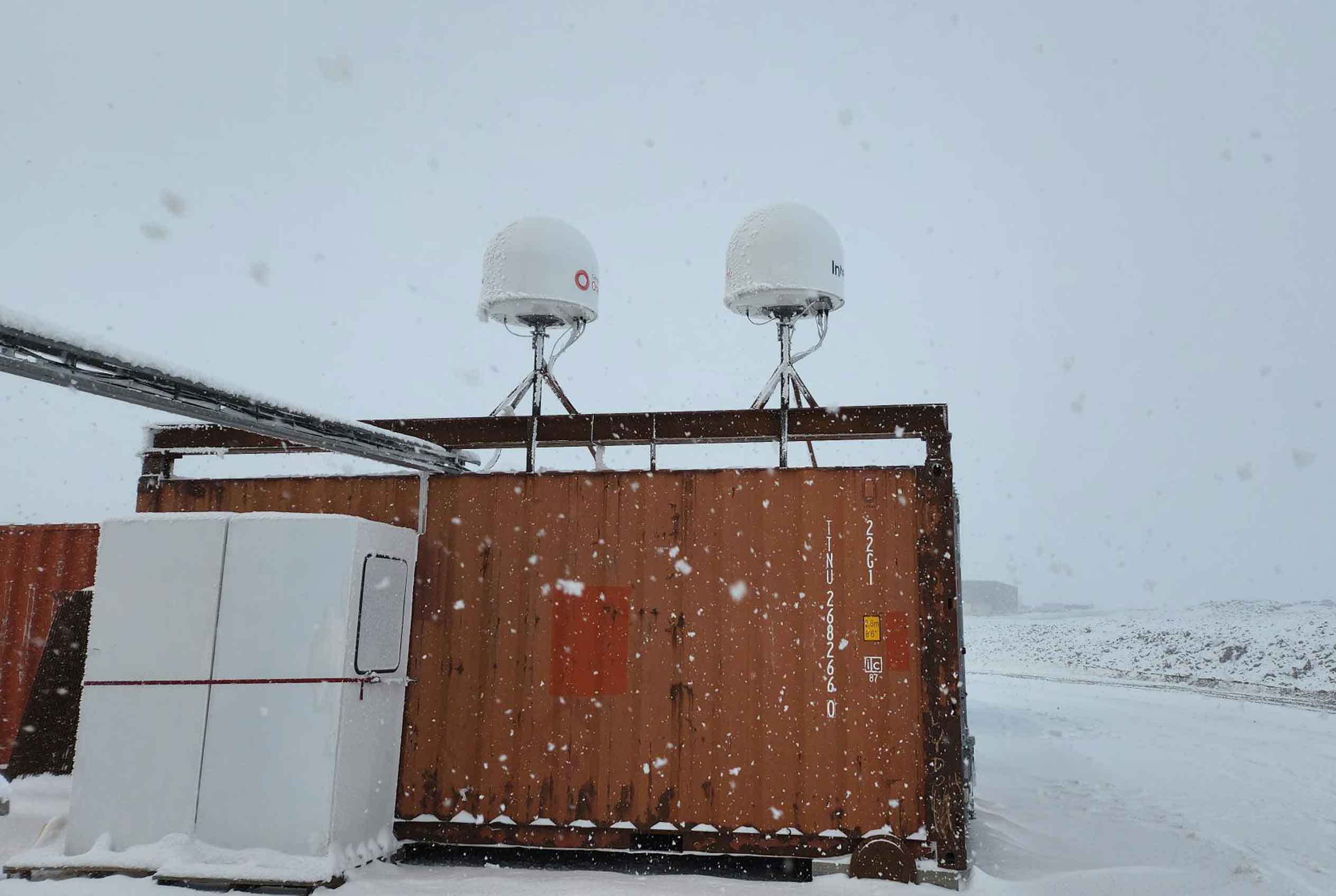
Running fiber-optic cable across the Canadian wilderness burns through capital. Plowing through permafrost and granite to connect a remote mining camp or pipeline station costs between $27,000 and $80,000 per mile.
For decades, industrial operators relied on traditional geostationary (GEO) satellites. Those systems orbit 36,000 kilometers away. Physics forces a massive delay for data traveling that distance. The resulting high latency breaks modern, cloud-based software.
Eutelsat OneWeb satellite technology eliminates this distance problem. Operating in Low Earth Orbit (LEO) at just 1,200 kilometers above the surface, this system delivers sub-70-millisecond latency and fiber-like speeds. This hardware provides low-latency satellite internet for industries operating entirely off the grid.
Enterprise satellite communication solutions now match the speed of urban corporate networks. This enables real-time edge computing, autonomous machinery control, and immediate data transfers from the most isolated locations on the map.
The Engineering Behind LEO Connectivity
The OneWeb system guarantees continuous, high-speed data delivery through pure scale and precise orbital geometry. The network uses 648 mass-produced satellites traveling at 27,000 kilometers per hour. These satellites complete a full orbit around the Earth every 109 minutes.
To ensure operators in the high north never drop a connection, engineers arranged the satellites across 12 near-polar orbital planes using a specific Walker-Star pattern. These orbital planes cross paths at higher latitudes. This design creates dense, overlapping radio frequency coverage directly over the Canadian Arctic, the Northwest Territories, and Nunavut.
The data routing relies on a “bent-pipe” mechanism. Ground stations, known as Satellite Network Portals (SNPs), transmit signals up to the satellites using the high-frequency Ka-band (27.5 to 30 GHz). The satellite acts as an immediate relay. It translates the signal and fires it down to the remote site using the Ku-band (10.7 to 12.7 GHz).
Engineers selected the Ku-band for the user downlink to beat the weather. High-frequency bands lose power when passing through moisture. The Ku-band easily pushes through heavy Canadian snowstorms and severe rain, keeping the link active when site crews need it most.
Because the first-generation OneWeb satellites do not use lasers to talk to each other in space, the system requires a direct line of sight to both the user and a ground station at the same time. Eutelsat OneWeb supports Canadian operations through a specialized SNP located in Yellowknife. This facility uses 27 distinct antenna bases to process heavy industrial traffic. OneWeb strictly isolates this data. Through Layer 2 connectivity, direct peering, and private IP routing, remote site traffic moves directly into corporate firewalls. It never touches the public internet.
Specialized Hardware for Harsh Environments
LEO satellites streak across the sky from horizon to horizon in a matter of minutes. Remote hardware must lock onto these signals, track them, and switch to the next satellite instantly. OneWeb partnered with major manufacturers like Intellian, Kymeta, and Hughes Network Systems to build distinct tiers of OneWeb Satellite Terminals designed specifically for industrial deployment.
Dual Parabolic Architecture
Stationary sites demanding absolute maximum uptime use dual parabolic systems. The Intellian OW70 sets the standard for this class. It solves the rapid LEO handover problem using a dual 3-axis stabilized pedestal. The primary antenna locks onto a satellite and streams data. At the same time, the secondary antenna scans the horizon, finds the next rising satellite, and waits. The exact millisecond the primary satellite drops below the required angle, the system switches the data stream to the secondary antenna. This creates a handover with zero packet loss.
These units take up significant space. The OW70 features dual domes measuring 85.6 centimeters across and weighing a combined 104 kilograms. To survive Canadian winters, they draw up to 200 watts of electrical power to run internal heaters. This heat stops drive belts from freezing solid and prevents ice from crushing the dome at -40°C.
Electronically Steered Antennas (ESA)
For sites with limited space or power, operators use flat panels. These OneWeb User Terminals completely remove physical motors. The Intellian flat panel antennas and Kymeta Hawk u8 rely on software-defined holographic beamforming. Thousands of microscopic elements within the panel electronically steer the radio frequency beam across the sky.
The Hughes HL1120W dual-panel system weighs just 24 kilograms and stands 11.2 centimeters tall. Despite its size, it hits the network’s maximum limit of 195 Mbps down and 32 Mbps up. The Kymeta Hawk u8 operates up to +55°C without internal fans. It stays cool relying purely on the thermal design of its solid-state electronics.
Hardware Specifications Summary:
- Intellian OW11FL: Flat Panel (ESA). 16 kg. 195 Mbps Down / 32 Mbps Up. Works from -40°C to +55°C (Heated).
- Hughes HL1120W: Flat Panel (ESA). 24.0 kg. 195 Mbps Down / 32 Mbps Up. IP67 rated against dust and water.
- Kymeta Hawk u8: Flat Panel (ESA). 30.1 kg. 195 Mbps Down / 32 Mbps Up. IP66 rated.
Edge Orchestration and Aggregation
Raw satellite speed requires smart local traffic management. OneWeb’s Enterprise Hub uses edge networking software to build a Software-Defined Wide Area Network (SD-WAN). The hub groups the OneWeb connection with any available backup path, like a local LTE tower or an older microwave link. Using deep packet inspection, the hub instantly forces high-priority traffic—like voice calls or SCADA telemetry—down the fast OneWeb path. It pushes heavy, non-urgent traffic, like bulk software updates, to the backup connection.
Mobility and Remote Sensors Exploration teams and logistics fleets use On-the-Go Installation Kits for Mobility. Manufacturers build ruggedized, waterproof pop-up cases for Hughes flat panels. This lets survey crews set up enterprise broadband minutes after parking their trucks. For continuous movement, Kymeta hardware mounts directly to vehicle roof racks. This maintains a fast downlink while a service truck drives down a rough logging road at highway speeds.
OneWeb Integration for IoT Devices fixes the remote sensor problem. The network allows small, battery-operated sensors on pipelines or remote farm fields to fire tiny bursts of data directly to the LEO satellites. This entirely removes the need to build expensive local cellular towers just to read a pressure gauge.
Data-Driven Industrial Operations
Fast internet in remote areas changes the operational limits of Canadian resource extraction. Satellite connectivity for oil & gas, mining, agriculture serves as the foundation for heavy automation.
The Digital Oilfield
Offshore platforms and remote drilling sites use OneWeb satellite solutions for business to run advanced Supervisory Control and Data Acquisition (SCADA) networks. Engineers send live wellbore pressure data and streaming video from underwater robots straight to onshore teams. Geologists analyze the data stream and adjust the drill path based on immediate feedback. This maximizes the oil extracted from the reservoir. Along the pipelines, direct-to-satellite IoT systems run automated leak detection, sending crews out before pressure drops cause a major spill.
Autonomous Mining
Older satellites failed to run modern mining software. Eutelsat OneWeb fixes this by providing the exact speeds needed to run central Enterprise Resource Planning (ERP) systems from deep inside a remote camp. Sub-70ms latency allows operators to set up Private 5G or LTE networks within the mine pit, backed by the OneWeb connection. This setup runs autonomous haul trucks and automated drilling rigs. These massive machines generate gigabytes of data to avoid collisions. Operators sit in control centers thousands of miles away, safely driving heavy equipment because the network reacts instantly.
Precision Agriculture
Large farming operations mount OneWeb Antennas directly to their combine harvesters. Farmers use remote satellite communication to download heavy multispectral image files—like daily crop health maps from space—right to the tractor cab. The machinery uses this data to change how much water, fertilizer, and pesticide it sprays, adjusting meter by meter. This precision cuts input costs, stops chemical runoff, and increases crop yields.
Logistics Integrity
Rail operators and trucking fleets driving across the Canadian Shield use mobile hardware to keep track of their assets. Terminals switch smoothly between satellite beams to send continuous GPS locations, engine diagnostics, and real-time refrigerated cargo temperatures. This guarantees the supply chain stays intact, even in total cellular dead zones.
Capital Allocation and Return on Investment
Consumer satellite internet targets individuals with cheap hardware and unstable speeds. Eutelsat OneWeb targets heavy industry. They offer strict Service Level Agreements (SLAs) and Committed Information Rates (CIR). A CIR means a drilling rig gets a dedicated baseline of bandwidth, no matter how many other people are using the network.
This certainty requires upfront capital. Hardware costs range from $7,000 for compact flat panels to over $44,000 for heavy-duty, heated dual parabolic systems. Setting up industrial satellite internet Canada brings high logistical costs. Flying technicians and heavy equipment via helicopter to a remote Nunavut site can push installation expenses past $20,000. For monthly operations, data fees start at $1,000 for shared configurations and go up to $5,000 or more for top-tier mobility plans.
The return on investment shows up quickly by preventing downtime. In heavy industry, network failure stops work. Losing communication with an offshore rig halts the drill, causing financial penalties that hit hundreds of thousands of dollars an hour. OneWeb’s SLA-backed, 99.5% guaranteed availability prevents these massive losses. In agriculture, precision farming enabled by fast internet improves fertilizer efficiency by 16% and cuts fuel use by 11%.
The OneWeb Satellite Installation Guide
Installing satellite hardware requires strict attention to aerospace tolerances and structural codes. A bad installation causes dropouts, breaks expensive hardware, and voids the enterprise warranty.
Phase 1: Line-of-Sight Engineering
Terminals need a perfectly clear 360-degree view of the sky down to low angles (+15 to +35 degrees). Installers run detailed 3D scans of the sky using specialized diagnostic tools. A single exhaust stack or crane in the way will block the signal right when the terminal tries to switch between satellites.
Phase 2: Structural Integrity and Alignment
Mounting dual parabolic systems takes heavy lifting and exact pedestal calibration. If the primary and secondary antennas do not line up perfectly, the system drops data when tracking satellites directly overhead. Flat panel ESAs need an exact 3-degree forward tilt. Installers use digital levels to ensure this angle perfectly drains melting snow away from the hardware face.
Phase 3: Electrical and Cabling Protocols
Enterprise systems use specific indoor power units. These push data and up to 380 watts of direct current into a single coaxial cable to power the outdoor antenna. Installers heavily shield these cables to block electrical noise from nearby heavy machinery. They run deep grounding wire, connecting surge protectors straight to the earth to deflect static buildup and lightning strikes.
Phase 4: Canadian Weather Defenses
Standard plastics shatter in the extreme cold. Installers wrap cable connections with thick, cold-weather tape to stop the weatherproofing seals from cracking at -40°C. They seal hardware to IP67 standards to block invasive salt spray on marine ships and highly abrasive rock dust in open-pit mines.
Enterprise Deployment and Integration
To actually get the promised 99.5% uptime from this network, operators need integration specialists who understand the hardware and the environment.
NTFS (National Technical Field Services) bridges the physical gap between the satellites in space and the local network on the ground. NTFS keeps a team of over 65 certified technicians across Canada. They hold the technical knowledge and the exact logistical reach needed to execute complex OneWeb satellite installation operations in the most hostile environments.
As the exclusive installation partner for major satellite manufacturers in Canada, NTFS handles every phase of the project. They run the initial 3D line-of-sight surveys, build the structural mounts, run the high-voltage cabling, and configure the local Enterprise Hubs to push traffic safely through corporate firewalls. They make sure all hardware meets ISED Canada regulations and strictly follow manufacturer rules to protect your equipment warranties.
NTFS satellite installation services provide end-to-end management, complete speed optimization, and round-the-clock maintenance. For seamless OneWeb satellite installation and ongoing support, trust NTFS to deliver the right solution for your business.